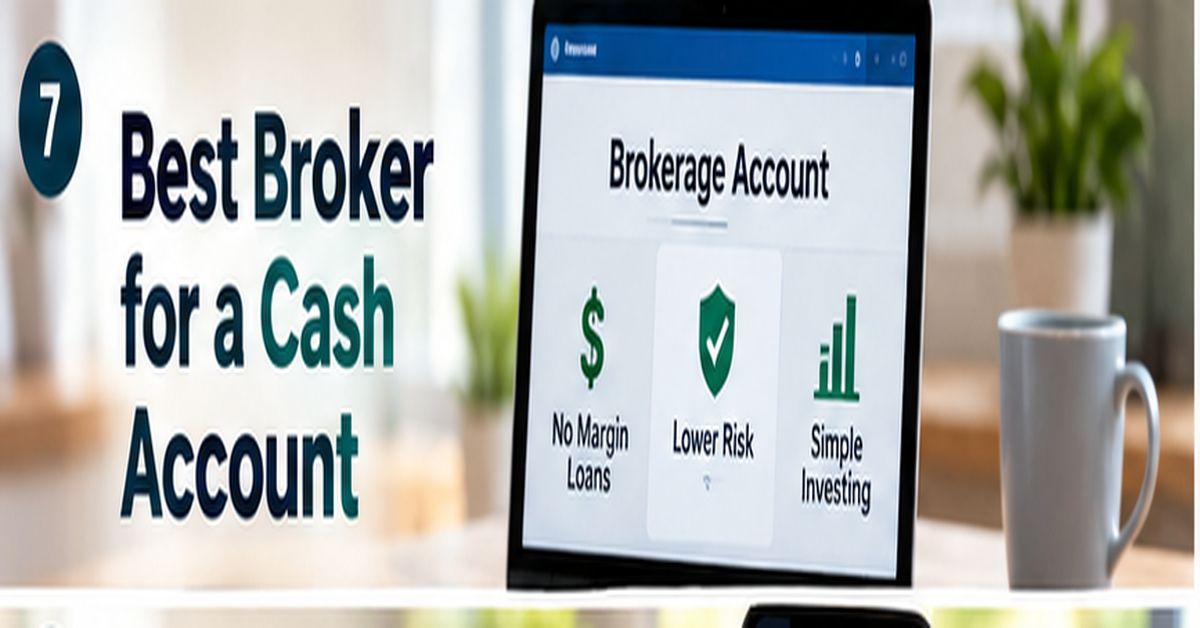
Finding the best broker for a cash account can be a good starting point for investors who do not want to borrow money from a brokerage firm to purchase securities. In a cash account, the investor generally pays the full amount for securities purchased rather than using margin.
That does not make a cash account risk-free. Stocks and other investments can lose value, and cash-account trading has its own rules that beginners should understand before placing trades.
What Is a Cash Brokerage Account?
A cash account is a brokerage account where you pay the full purchase price of securities. Unlike a margin account, you cannot borrow from the broker to fund purchases.
This distinction is important because margin can increase purchasing power but also increase potential losses and create borrowing costs.
For beginners, a cash account can therefore be worth considering when the goal is to avoid margin borrowing.
However, investors still need to understand settlement requirements and the broker’s own account policies.
What Should You Look for in the Best Cash Account Broker?
There is no universally best broker for everyone. Instead, compare the features that matter to your type of investing.
| Feature | Why it matters |
|---|---|
| $0 online stock commissions | Can reduce certain transaction costs |
| Account minimum | Important for beginners with smaller balances |
| Fractional shares | May make smaller investments easier |
| Research tools | Useful for evaluating investments |
| Mobile app | Important for investors managing accounts on mobile |
| Customer support | Helpful when account questions arise |
| Cash management | Useful when uninvested money remains in the account |
| Options availability | Relevant if you may expand beyond stocks |
Fidelity currently advertises $0 online commissions for US stock and ETF trades and no fee to open a retail brokerage account, subject to its terms.
Charles Schwab currently advertises $0 online commissions for listed stocks and ETFs, with its separate options contract pricing applying when options are traded.
These are examples rather than an endorsement. Pricing and account features can change.
Cash Account vs. Margin Account
The biggest difference is borrowing.
A cash account requires the investor to pay the full amount for a security. A margin account allows the broker to lend money against eligible securities held in the account.
Margin can increase purchasing power, but the SEC warns that losses can become substantially larger and a broker may require additional funds or sell securities in some circumstances.
For someone specifically searching for a cash account, one useful step is to verify the account type carefully during the application process. The SEC has warned that some brokerage applications can make margin the default account type.
Cash-Account Trading Rules to Understand
Cash trading still has restrictions.
For example, the SEC’s updated Investor Bulletin on trading in cash accounts discusses Regulation T and the consequences of certain trading activity, including a possible 90-day account freeze for freeriding.
Beginners should therefore avoid treating a cash account as a loophole around trading rules.
Before frequent trading, learn:
- When funds become available for trading
- Your broker’s settlement procedures
- Restrictions on selling recently purchased securities
- Rules concerning unsettled funds
- How your broker handles trading violations
How to Compare Brokers
Create a simple comparison table using the same criteria for every broker.
Check the official pricing page, account agreement, cash-account disclosures, and available trading tools.
Also investigate the broker or firm before opening an account. FINRA’s BrokerCheck provides information about registered brokers and firms, including regulatory information and disciplinary history.
FAQ
What is the best broker for a cash account?
The best broker depends on your priorities. Compare commissions, account minimums, fractional shares, research, cash-management features, customer service, and platform usability.
Is a cash account safer than a margin account?
A cash account avoids borrowing money from the broker, but investments can still lose value. A margin account introduces additional borrowing and margin-call risks.
Can you day trade in a cash account?
Trading is subject to cash-account rules and settlement requirements. Frequent traders should understand their broker’s specific policies before attempting day-trading activity.
Conclusion
The best broker for a cash account is not necessarily the broker with the lowest advertised commission. Look at the entire account experience, including fees, research, customer support, cash-management features, platform usability, and account rules.
Before opening an account, confirm that you are selecting the account type you actually want and review the broker’s current disclosures.
Risk disclaimer: This article is for educational purposes only and is not personalized financial, investment, tax, or legal advice. Investing involves risk, including loss of principal. Broker pricing, account features, and regulations may change.